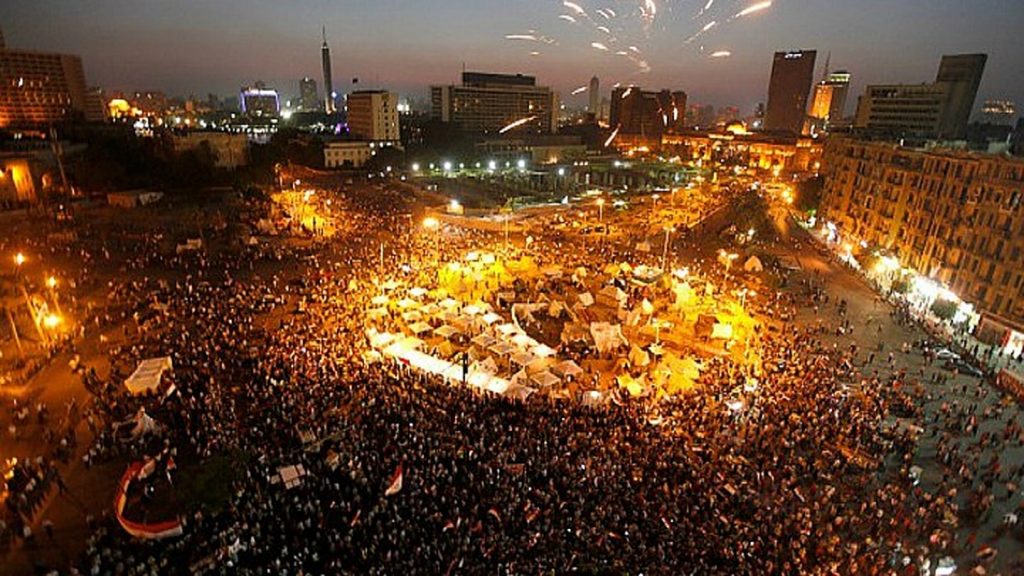
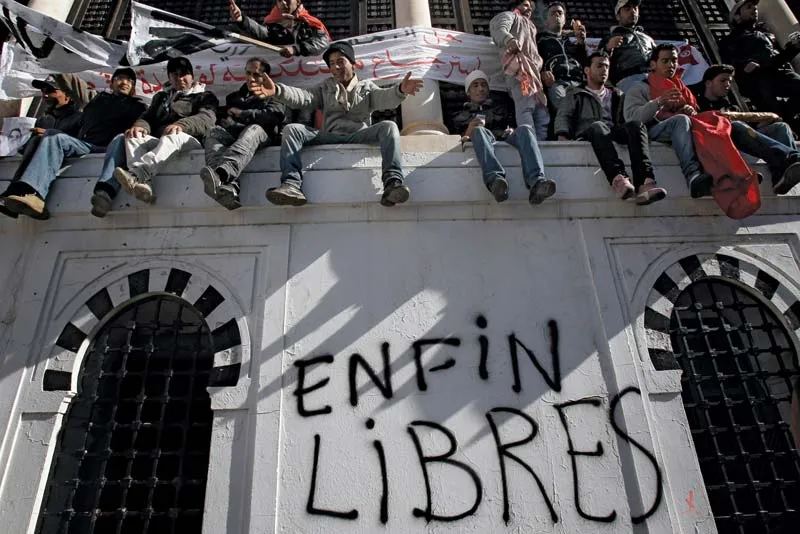
The self-immolation of Mohamed Bouazizi was the catalyst that ignited the Arab Spring, but the underlying conditions had been building for decades. Here is the context of the events leading up to and following December 17, 2010.
The Spark: Mohamed Bouazizi
On December 17, 2010, in the central Tunisian town of Sidi Bouzid, Mohamed Bouazizi, a 26-year-old street vendor, set himself on fire outside a local government office. This desperate act was a direct response to police confiscating his produce scales, the subsequent humiliation, and the refusal of local officials to hear his complaint.
Underlying Causes
Bouazizi’s act resonated instantly because it symbolized the shared frustrations of millions. The environment leading up to the uprisings was defined by three core pillars:
Economic Stagnation: High youth unemployment (particularly among university graduates), rising global food prices, low wages, and a rapidly growing youth demographic bulge with no economic prospects.
Political Repression: Decades of authoritarian rule under entrenched dictatorships. Citizens faced state police brutality, lack of freedom of speech, sham elections, and severe human rights abuses.
Systemic Corruption: Kleptocratic regimes where wealth was concentrated within the ruling elite and their inner circles. Ordinary citizens were forced to navigate a daily system of bribes and patronage just to survive.
The Jasmine Revolution (Tunisia)
The ensuing protests in Tunisia—dubbed the “Jasmine Revolution”—escalated rapidly. They were uniquely fueled by social media networks and satellite broadcasters like Al Jazeera, which bypassed state-controlled media to share real-time footage of the crackdowns. The sheer volume of protests forced President Zine El Abidine Ben Ali, who had ruled for 23 years, to flee to Saudi Arabia on January 14, 2011.
The Arab Spring: The Ripple Effect
Tunisia’s success broke the barrier of fear across the region. Citizens in neighboring countries realized that heavily militarized regimes could be toppled by sustained popular mobilization. However, the trajectory of these uprisings varied drastically depending on military loyalties, foreign intervention, and sectarian divides.
Comparative Outcomes
Country
Pre-2010 Leadership
Immediate Outcome (2011-2012)
Long-Term Result
Tunisia
Zine El Abidine Ben Ali
Ousted (Jan 2011)
Initial democratic transition, though currently facing institutional backsliding.
Egypt
Hosni Mubarak
Ousted (Feb 2011)
Brief democratic period; military coup (2013) led to a return to authoritarianism.
Libya
Muammar Gaddafi
Overthrown & killed (Oct 2011)
Fractured state, civil war, and competing governments.
Syria
Bashar al-Assad
Uprisings met with military force
Protracted civil war, massive refugee crisis; Assad remains in power.
Yemen
Ali Abdullah Saleh
Resigned (Feb 2012)
State collapse, proxy war, and severe humanitarian crisis.
A love letter to Arsenal FC and a polite — very polite — message to everyone else.
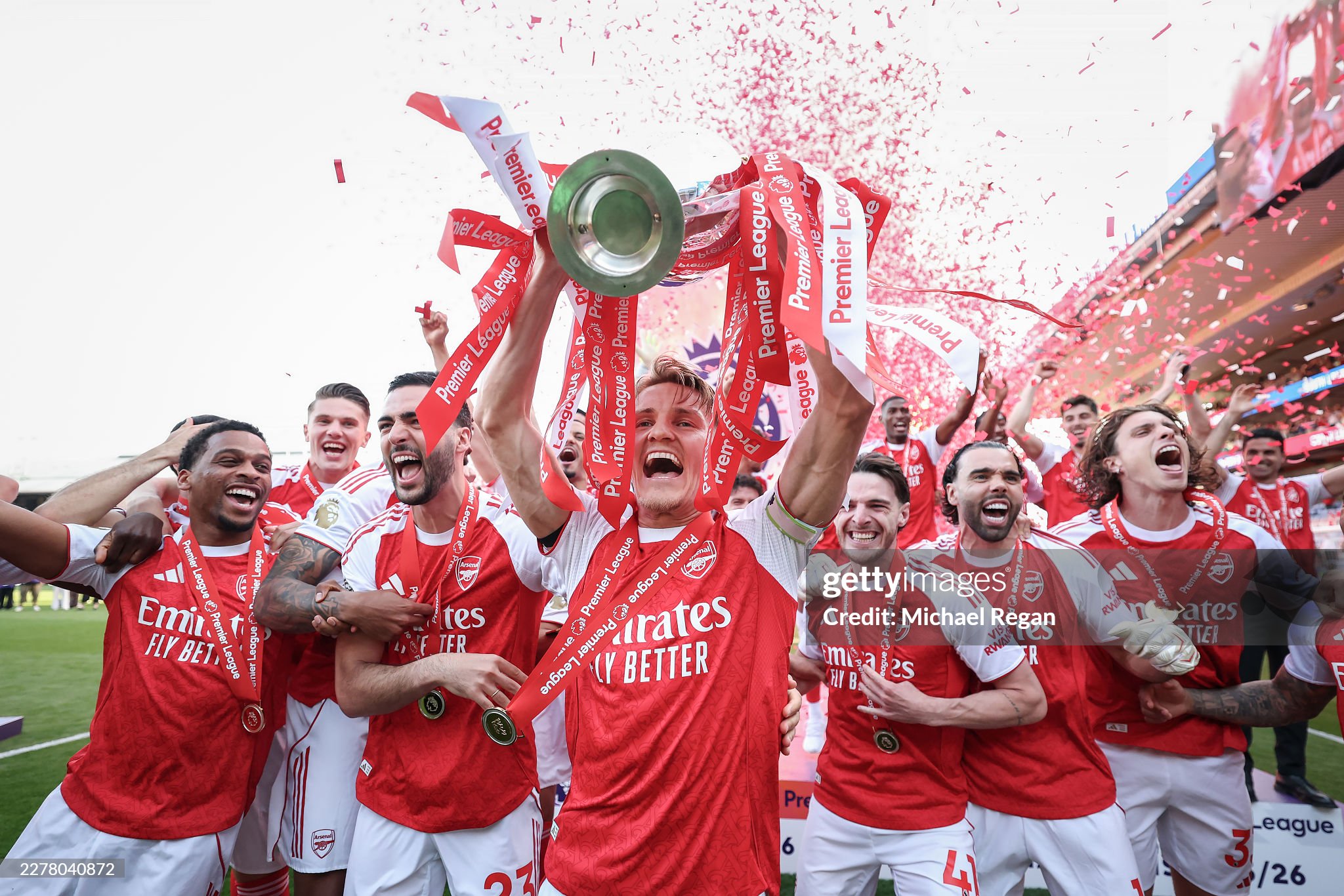
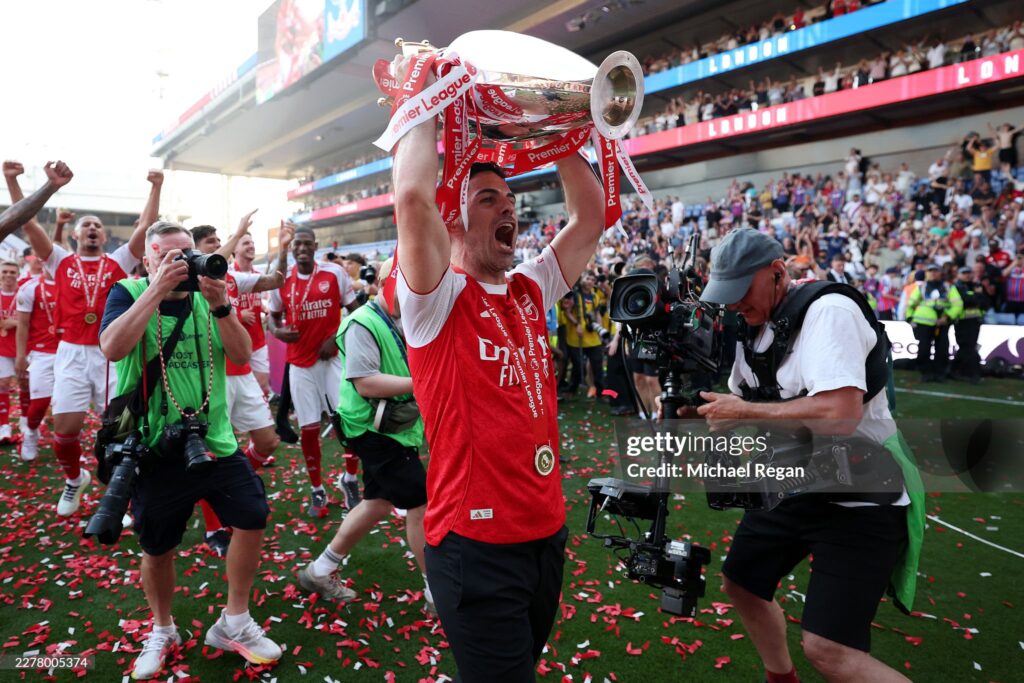
LONDON, ENGLAND – MAY 24: Martin Odegaard of Arsenal lifts the Premier League trophy during the Premier League match between Crystal Palace and Arsenal at Selhurst Park on May 24, 2026 in London, England. (Photo by Michael Regan/Getty Images For Premier League)
Twenty-Two Years. Let That Sink In.
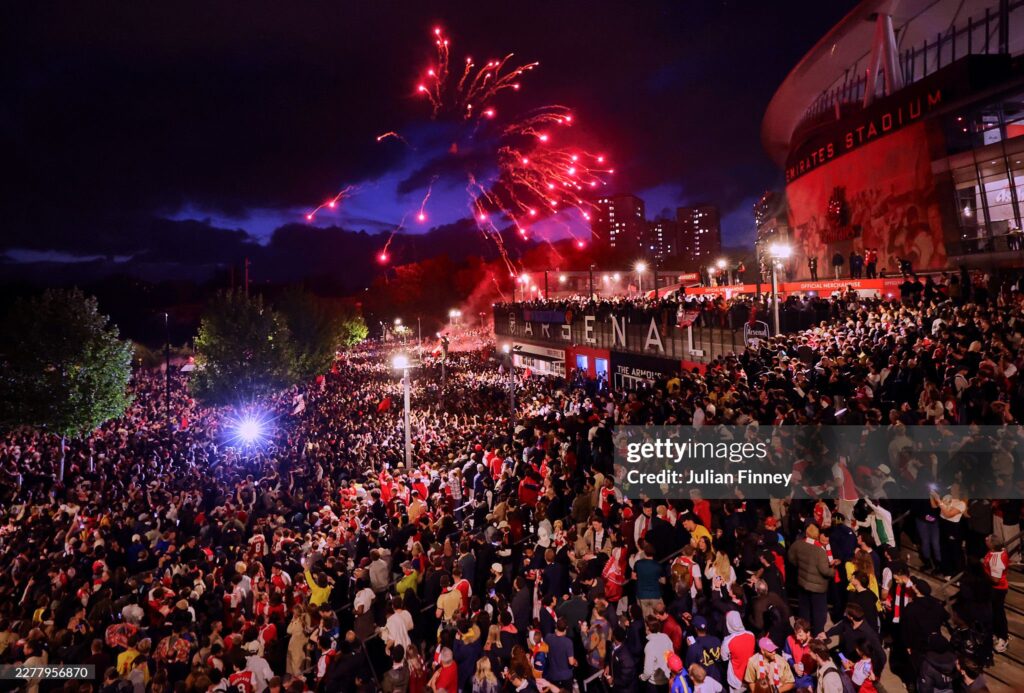
LONDON, ENGLAND – MAY 19: Arsenal fans celebrate winning the Premier League after Manchester City failed to win away to Bournemouth at Emirates Stadium on May 19, 2026 in London, England. (Photo by Julian Finney/Getty Images)
Twenty-two years. That’s not just a wait — that’s a generational sentence. Kids who were born the last time Arsenal lifted that trophy are now working full-time jobs, paying rent, and watching this team finally do what it was always destined to do.
I was there through all of it. The fourth-place trophies. The top-four “achievements.” The years of Wenger’s dignity masking genuine pain. The Emery era — we don’t talk about the Emery era. The Arteta rebuild, watched from the sidelines like a man nursing a wound. Three consecutive runner-up finishes, including that gut-punch in 2023/24 when Manchester City snatched it by two miserable points.
But on the evening of 20 May 2026, when Manchester City drew 1-1 at Bournemouth, leaving them four points adrift with one game to play, the noise that came out of me was not human. I don’t care where you were — I was in it. And if you’re a Gooner reading this from Male’, from London, from wherever — you know exactly what I mean.
Arsenal secured their 14th top-flight English title with a game to spare, after beating Burnley 1-0 at the Emirates, putting the pressure squarely on City’s shoulders — and City crumbled. Beautiful. Absolutely beautiful.
Mikel Arteta — The Man. The Myth. The Champion.
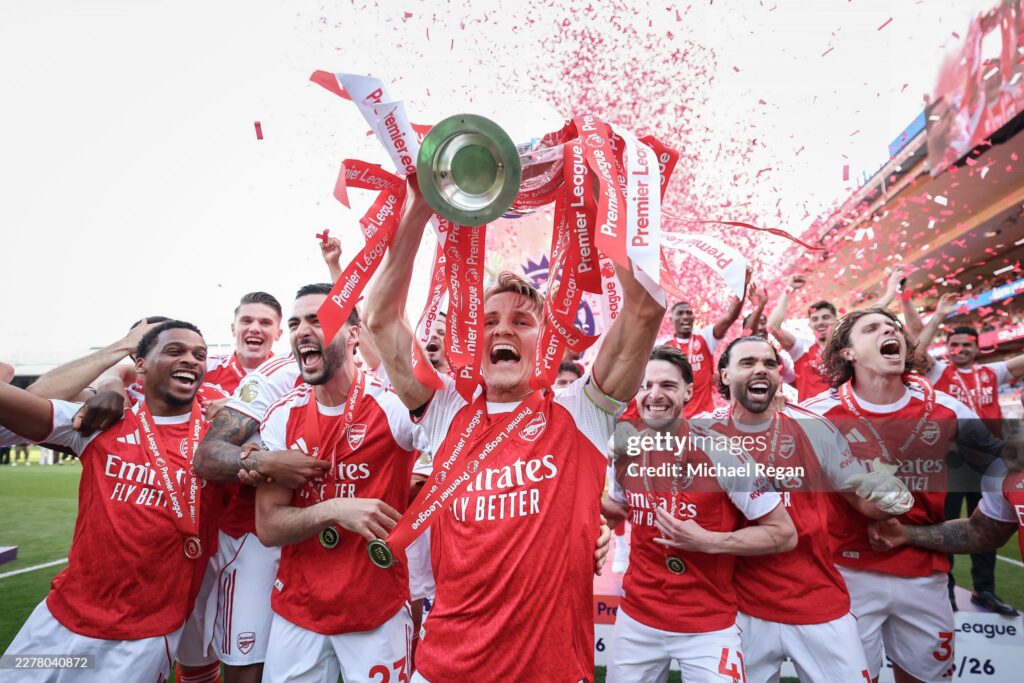
LONDON, ENGLAND – MAY 24: Mikel Arteta, Manager of Arsenal, lifts the Premier League trophy as players of Arsenal celebrate, as they are crowned the Champions of the Premier League for the 2025/26 Season, after the Premier League match between Crystal Palace and Arsenal at Selhurst Park on May 24, 2026 in London, England. (Photo by Michael Regan/Getty Images For Premier League)
Mikel Arteta becomes the first Gunners boss to lift the Premier League trophy in 22 years, following in the footsteps of Arsène Wenger’s legendary Invincibles of 2003/04.
The man was criticised from day one. Too young. Too inexperienced. Too intense. Too… tactical. People wanted him out after losses. Pundits questioned his squad decisions. And now? He’s a Premier League champion. Write that down.
“But the Style, though…” — Yeah, Okay. The Trophy Says Otherwise.
I know what they said. “Arsenal are boring.”“It’s set-piece football.”“Where’s the flair?” Let me address this with the patience I have left, which is approximately none.
Arsenal conceded the fewest goals in the league — just 26 — with David Raya winning the Golden Glove for the third successive season with 19 clean sheets. They also won a league-best 25 of their 37 matches.
The Gunners netted 69 goals across 37 league games — a tally bested only by Manchester City.
So let me get this straight: best defensive record in the league, second-highest scorers, most wins, fewest goals conceded — and the argument is the style wasn’t pretty enough? Mate, style doesn’t go in the trophy cabinet. Hardware does. And we have hardware.
You want pretty? Go watch a ballet. We’re champions.
“The League Standard Has Dropped” — Possibly the Most Embarrassing Take of 2026
Right, so apparently winning this title “doesn’t count” because the Premier League is weaker this season. Let me introduce the pundits making this claim to something called evidence.
Look at who finished behind us:
Manchester City 78 points, 23 wins, 9 draws — hardly a collapse
Manchester United 71 points, 20 wins, 11 draws — third place
Aston Villa 65 points, 19 wins, Champions League qualified
Liverpool 60 points, 17 wins, Champions League qualified
Bournemouth 57 points, 14-match unbeaten run, Europa League
Sunderland 54 points, Promoted, 7th place, Europa League
Brighton 53 points, Conference League qualified
That’s seven clubs in European competition. A newly promoted side (Sunderland) finishing 7th with 54 points. Bournemouth — Bournemouth! — going on a 14-match unbeaten run, the longest in the entire league. Aston Villa went on their best winning streak in the top division since 1910 — eight consecutive victories.
This league ate every single team alive from top to bottom. 931 goals were scored across 340 matches — averaging 2.74 per game. That’s not a weak league. That’s a league absolutely stacked with quality, competition, and chaos. And Arsenal rose above all of it.
If anything, winning this title in this environment makes it more impressive, not less.
A Few Words for Our Beloved Rivals
Liverpool — Five Champions League titles, 20 league titles, and you still finished fifth. Fifth! Behind Manchester United! I genuinely hope that stings appropriately. You had a full summer rebuild and still couldn’t hold it together. We wish you well. (We really don’t.)
Chelsea — £1 billion in transfers and you’re watching Bournemouth qualify for Europe ahead of you. Absolute cinema. Your squad has more players than a small nation and yet, here we are. Maybe try buying a manager next time who lasts longer than a phone contract..
Manchester United — Third place, which is impressive, we’ll give you that. Bruno Fernandes broke the all-time assists record with 21 — surpassing Thierry Henry and Kevin De Bruyne’s previous record of 20 — and you still finished 11 points behind us. Congratulations on the consolation prize.
Tottenham — We’d say something, but honestly, we’re too happy to bother. You know what you are. You’ve always known. We are Tottenham’s landlords and we just renovated the house.
This Is the Most Competitive League in the World — Full Stop
Anyone still peddling the “weak league” narrative needs to explain how a promoted Sunderland side finished higher than Chelsea. Needs to explain how Bournemouth — a club that was in League One not long ago — went on a 14-game unbeaten run and qualified for Europe. Needs to explain how Brighton, with their model-club philosophy, keep punching above their weight year after year into Conference League football.
The Premier League doesn’t have weak seasons. It has seasons where the best team earns the right to call itself champion. This year, that team wore red and white, played out of North London, and hadn’t done it in 22 years.
Final Word
This trophy isn’t just for the analysts, the tacticians, or the fair-weather fans who come out when it’s comfortable. This one’s for every Gooner who sat through the painful near-misses, who defended Arteta when others called for his head, who believed even when logic said don’t.
We now have the chance to cap one of the greatest seasons in our 140-year history — with a Champions League final against PSG in Budapest on 30 May.
Premier League champions. And potentially European royalty.